Altlayer builds custom rollup infrastructure and tools for on-chain AI agents
Altlayer provides rollup deployment services and infrastructure for AI agents that discover services, access models, and make on-chain payments. Its Rollups-as-a-Service offering supports stacks including OP Stack and Arbitrum Orbit. A separate restaked rollup framework uses EigenLayer-based services for verification, fast finality, and decentralized sequencing. Agent products include the ERC-8004 explorer 8004scan, the AltLLM model platform, and x402 payment infrastructure. These tools address distinct needs, so an application's requirements determine which components belong together.
Last updated:
On this page
Deploying Application-Specific Rollups
RaaS provides a managed route to launching an application-specific rollup on a supported stack. A rollup processes transactions in its own execution environment and relies on its configured settlement and data arrangements. That separation lets an application use dedicated infrastructure with settings suited to its workload. The service supports deployment and management through a no-code interface. Its managed offering includes explorers, bridges, and monitoring, alongside node scaling and recovery from disruptions. Application contracts, access controls, and the selected rollup architecture still determine what the deployed system actually permits.
OP Stack, Arbitrum Orbit, ZK Stack, and Polygon CDK provide supported foundations with different configuration options. The chosen stack and deployment version determine which settings apply. The project's 2025 expansion included Starknet-based deployments and non-EVM environments. That year's infrastructure work spanned gaming, social platforms, DeFi, AI-focused rollups, and Bitcoin-adjacent ecosystems.
Verification, Finality, And Sequencing
The restaked rollup framework assigns state verification, fast finality, and transaction ordering to separate modular services. An Actively Validated Service, or AVS, uses operators to perform its defined task within a shared-security model.
VITAL And State Correctness
VITAL handles decentralized verification of rollup state. Its role concerns whether the state that a rollup reports matches transaction execution. This matters when another system must rely on that state before taking action, including cross-rollup communication.
MACH And Fast Finality
MACH provides crypto-economic fast finality for integrated rollups. Its economic backing comes through the restaking architecture. A fast-finality assurance has its own operator and security assumptions; it does not make every underlying settlement process complete at the same moment.
SQUAD And Transaction Ordering
SQUAD addresses decentralized sequencing, the ordering of transactions before execution. A deployment's AVS integrations determine which of those services it uses. Operator selection, rewards, and slashing rules belong to the service configuration. Those choices determine who performs the work and what economic consequences apply when an operator violates its rules.
Execution, Data Availability, And Settlement
A rollup's execution stack and data availability layer determine different parts of its operating model. Execution processes transactions and updates state, while data availability concerns access to the data needed to reconstruct and assess those updates. Settlement establishes the rollup's commitments under the rules of its selected settlement layer.
The RaaS offering lists Celestia, EigenDA, and Avail among its data availability options. These services occupy a different architectural role from OP Stack or Arbitrum Orbit. Choosing an execution framework therefore leaves a separate data availability decision. The options that work together depend on the supported integration, not simply their appearance in a platform-wide list.
The multi-VM design targets both Ethereum Virtual Machine (EVM) and WebAssembly (WASM) environments. The chosen stack determines which execution environment applies. That modularity also affects security assumptions. A change in data availability does not automatically preserve every property of another configuration. The chain's verification, data access, and settlement arrangements must make sense together.
Persistent And Ephemeral Rollups
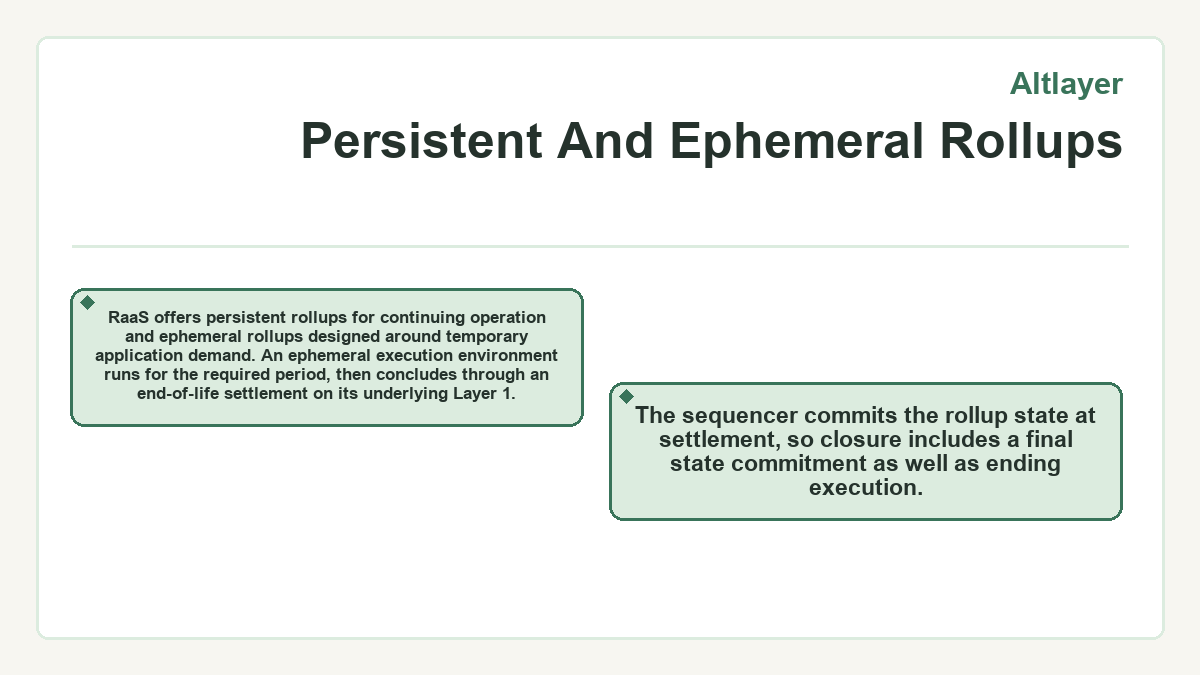
RaaS offers persistent rollups for continuing operation and ephemeral rollups designed around temporary application demand. An ephemeral execution environment runs for the required period, then concludes through an end-of-life settlement on its underlying Layer 1. The sequencer commits the rollup state at settlement, so closure includes a final state commitment as well as ending execution.
Product Options And Their Scope
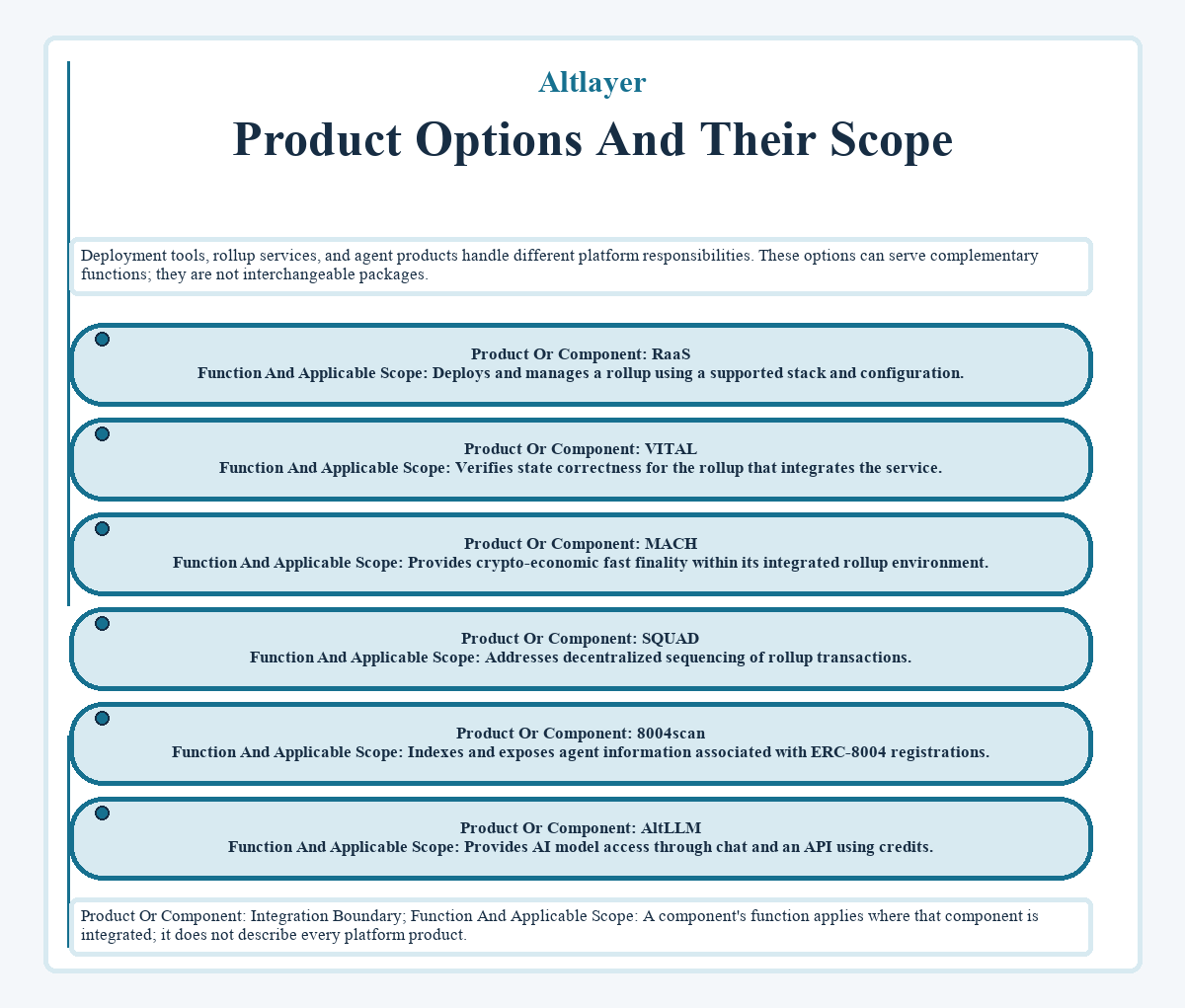
Deployment tools, rollup services, and agent products handle different platform responsibilities. These options can serve complementary functions; they are not interchangeable packages.
| Product Or Component | Function And Applicable Scope |
|---|---|
| RaaS | Deploys and manages a rollup using a supported stack and configuration. |
| VITAL | Verifies state correctness for the rollup that integrates the service. |
| MACH | Provides crypto-economic fast finality within its integrated rollup environment. |
| SQUAD | Addresses decentralized sequencing of rollup transactions. |
| 8004scan | Indexes and exposes agent information associated with ERC-8004 registrations. |
| AltLLM | Provides AI model access through chat and an API using credits. |
| Integration Boundary | A component's function applies where that component is integrated; it does not describe every platform product. |
ALT And the Restaking System
The documented ALT staking system accepts ALT on Ethereum mainnet and pays staking rewards in ALT. Its interface distinguishes ALT, staked ALT (stALT), and restaked ALT (reALT). Participation requires ALT in the connected wallet and sufficient ETH to pay Ethereum transaction gas.
The broader restaked rollup framework draws on EigenLayer's restaking mechanism to support operator security. That architecture and the ALT holder's staking position are related parts of the ecosystem, with different participation rules. During 2025, the project also reported enabling ALT transfers between Ethereum and Solana through Wormhole. Token transfer support across networks does not extend the Ethereum staking interface to every destination network.
ERC-8004 Agent Discovery
8004scan makes ERC-8004 agents discoverable through indexed registrations and agent metadata. It provides an agent registry and explorer, with tools for creating registrations and inspecting what agents advertise. Agent capabilities and service interfaces become easier to locate through that common representation.
The explorer's activity feeds and network information add context beyond an agent's description. Registration identifies a listed agent; it does not certify the quality of every future response. Reputation and observed activity can inform a decision about using a service, while the requested task determines what evidence of correctness matters.
How Do x402 Payments Reach Settlement?
For a paid API request, x402 connects the service's payment requirements to a client's authorization and on-chain settlement. This supports automated purchases of data, compute, or agent services.
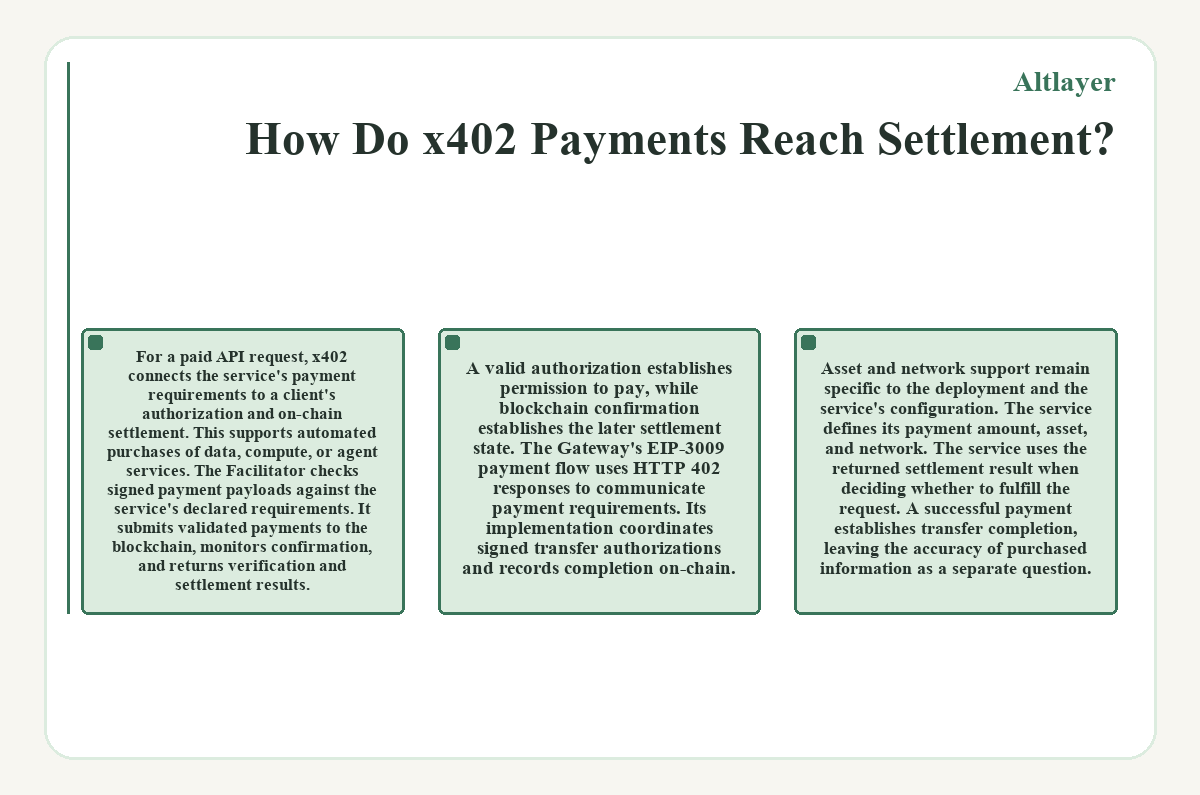
The Facilitator checks signed payment payloads against the service's declared requirements. It submits validated payments to the blockchain, monitors confirmation, and returns verification and settlement results. A valid authorization establishes permission to pay, while blockchain confirmation establishes the later settlement state.
The Gateway's EIP-3009 payment flow uses HTTP 402 responses to communicate payment requirements. Its implementation coordinates signed transfer authorizations and records completion on-chain. Asset and network support remain specific to the deployment and the service's configuration.
The service defines its payment amount, asset, and network. The service uses the returned settlement result when deciding whether to fulfill the request. A successful payment establishes transfer completion, leaving the accuracy of purchased information as a separate question.
AI Model Access Through AltLLM
AltLLM supplies AI model access through a shared chat interface and API, using credits for consumption. It supports access to frontier and open-source models and provides a common interface for comparing outputs. Programmatic access connects model calls to application workflows. Model access serves a different purpose from registering an agent or operating its payment infrastructure. A model generates output; an application determines how that output becomes an action. AltLLM also supports deploying agents connected to on-chain actions, making the permissions assigned to those agents consequential. Credit allocations and deployment resources vary by service tier.
Wizard, Autonome, And Rumour
Wizard and Autonome extended the project's infrastructure work into AVS operations and on-chain agents during 2025. Wizard is an AVS-as-a-Service tool for configuring, deploying, and managing services, including operator orchestration, service registration, and lifecycle management. Its use cases include fast-finality layers, decentralized sequencing, data availability services, and application-specific security modules. The service logic and applicable operator rules remain specific to the AVS.
Autonome addresses autonomous agents that coordinate and transact in decentralized environments. It connects agent development with blockchain execution and verification concerns. Its role differs from 8004scan's discovery and observation functions, although both belong to the broader agent infrastructure effort.
Rumour connects market-signal discovery, community credibility assessment, and trade execution. The project reported its 2025 launch and integration with Hyperliquid. Community assessment does not turn an unconfirmed market signal into an established fact. That information risk remains relevant when a trading interface reduces the distance between discovering a claim and acting on it.
Applications, Research, And Operational Assurance
ClawNews, ClawSearch, and Ottie apply agent infrastructure to concrete services, alongside separate blockchain and cryptography research projects.
Applications Built Around Agents
ClawNews is a social news aggregation platform for agents, with ERC-8004 reputation features. ClawSearch addresses machine-oriented discovery and retrieval of on-chain and off-chain information. AltLLM powers both products. Ottie addresses autonomous blockchain operations across multiple chains. Giving an agent access to transaction functions makes its authorization scope directly relevant to the assets and operations that it can affect.
Research Implementations
ETH2030
ETH2030 is an experimental Ethereum execution client exploring the Ethereum Foundation's 2030 Strawmap. Its stated work includes post-quantum cryptography, native rollups, three-slot finality, and PeerDAS. An experimental implementation explores those designs; its feature list does not establish their activation on Ethereum mainnet.
altpq
altpq implements post-quantum cryptography in Go, including ML-KEM, ML-DSA, and SLH-DSA. Its scope references the NIST FIPS 203, 204, and 205 standards. The implementations use pure Go and require no CGO or assembly dependencies.
Operational Assurance
Altlayer reports completed SOC 2 Type I and Type II audits and ISO/IEC 27001:2022 certification for its infrastructure operations. The audits and certification concern organizational controls and information-security management, distinct from application-contract verification or assessing an agent's output. Managed RaaS also provides DDoS mitigation and configurable rate limiting to support infrastructure availability. Rate limits also constrain the request traffic that an application can send to managed endpoints.
Altlayer: quick answers
Does Every Altlayer Rollup Support a Custom Gas Token?
Custom gas-token support varies by stack and deployment version. The documented OP Stack v1.7.0 setup supports only the parent chain's native token, while the Orbit offering supports a custom gas token. Orbit's documented gas-token option does not include support for custom validator stake tokens. Gas payment and validator staking are different functions.
Can Operators Host Their Own Full Nodes for Altlayer Rollups?
Self-hosted full nodes are supported in the documented OP Stack and Arbitrum Orbit offerings. Altlayer can provide launch scripts on request. These nodes can serve query-intensive applications such as indexers. Hosting a full node provides a separate way to query the chain; it does not by itself confer control over sequencing.
Which Rollup Endpoints Can Use a Custom Domain?
The documented OP Stack and Arbitrum Orbit offerings allow custom domains for RPC, explorer, and available WebSocket endpoints. The setup uses DNS CNAME records pointing at the targets that the service provides. A WebSocket endpoint belongs in that configuration only when the deployment includes one.
Is ALT Available Immediately After an Unstaking Request?
The documented Ethereum mainnet ALT unstaking process includes a 21-day cooldown before redemption. The holder first converts the requested amount of reALT back to stALT before initiating cooldown. Tokens in cooldown do not earn rewards. The holder must redeem them after the waiting period; starting cooldown does not complete redemption.
What Does the AltLLM Free Tier Include?
AltLLM offers a free tier with welcome credit and community support. Paid tiers include different credit allocations and deployment resources, so free access does not imply unlimited model calls or identical agent-hosting resources across every plan.
Why Can External Data Availability Add Costs Beyond Settlement Fees?
External data availability can add a separate storage charge to settlement costs. In the documented OP deployment, smaller settlement data reduces settlement costs without including data availability storage fees. The operator may need to cover those charges on the data availability network, so the settlement fee alone does not describe total transaction-related costs.